What happened
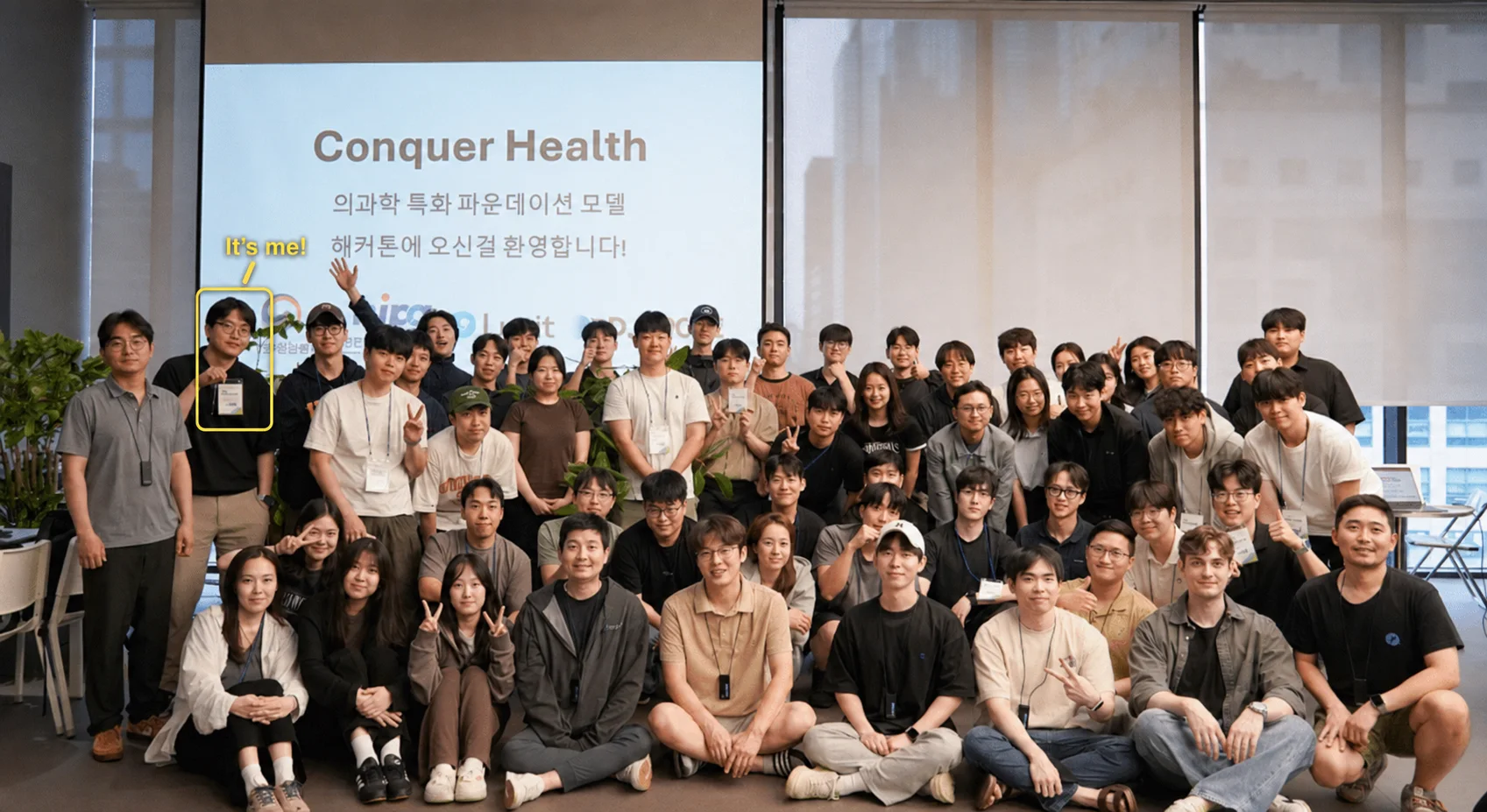
Lunit held its first Medical Foundation Model Hackathon at its Seoul headquarters on 21 and 22 August 2026. According to Lunit’s official announcement, 15 teams and roughly 70 developers, clinicians, students, and engineers participated using the company’s L2-preview medical foundation model.
The event combined a public-facing medical question-answering or health-service task with a benchmark track. Participants generated answers to the same medical and healthcare questions, received a comparative score, and iterated against a live ranking during the event. Clinicians and members of the model-development team also evaluated medical accuracy and potential practical use.
Our result
Team AIM—Park Juhee, Park Jiwoo, An Gyunseung, Kanghoun Lee, and Lee Jangwon—received the Benchmark Award. Lunit’s announcement states that the team achieved medical-science benchmark performance comparable to global frontier models. On this site I describe that result more narrowly as first place on the event’s benchmark track.
What the award demonstrates
The result shows that our team could adapt quickly to a new model and evaluation environment, build an effective response pipeline under time pressure, and improve it using benchmark feedback. It also became a useful test of how medical-domain retrieval, prompting, answer structure, and model behavior interact when everyone is evaluated on the same questions.
What it does not demonstrate
A hackathon leaderboard is not a clinical validation study. The result does not establish safety for patient care, general superiority across medical tasks, or performance outside the organizer’s evaluation set. The underlying model, judging process, and benchmark were controlled by the organizer, and the official performance claim has not been independently reproduced here.
Why I am keeping the record
The photograph and award are easy to display; the boundary is more important. This was a strong competition result obtained in a specific two-day setting. It belongs in the portfolio as evidence of rapid technical execution and team performance—not as a clinical claim.