The question that started it
I kept wondering why radiotherapy planning challenges so often depend on an equipment company or a one-off development effort. The people with the most useful clinical questions may be a medical society, a hospital, or a small research group. They may already have the expertise, a dataset, and participants—but not the software and operating team needed to run a challenge safely.
Orcaton is my attempt to test a different model: could those groups operate their own reproducible competition without first waiting for a vendor to organize it or building an entire platform from scratch?
What the first real event taught me
This was not a question I invented in isolation. I first built and operated AccurayLab for an actual treatment-planning competition. Seven final plans passed through a shared evaluation workflow, with 36 structures processed per plan and an anonymized 150-point leaderboard. That experience showed that the difficult part was not merely calculating a score. It was coordinating rules, files, identities, failures, versions, and evidence from beginning to end.
Orcaton generalizes that operating model beyond one vendor-associated event. A credible medical challenge still needs someone to define the clinical question, establish data rights and evaluation rules, approve participants, keep hidden labels hidden, version the scorer, handle failures, and leave a record another team can audit.
One control plane, three verticals
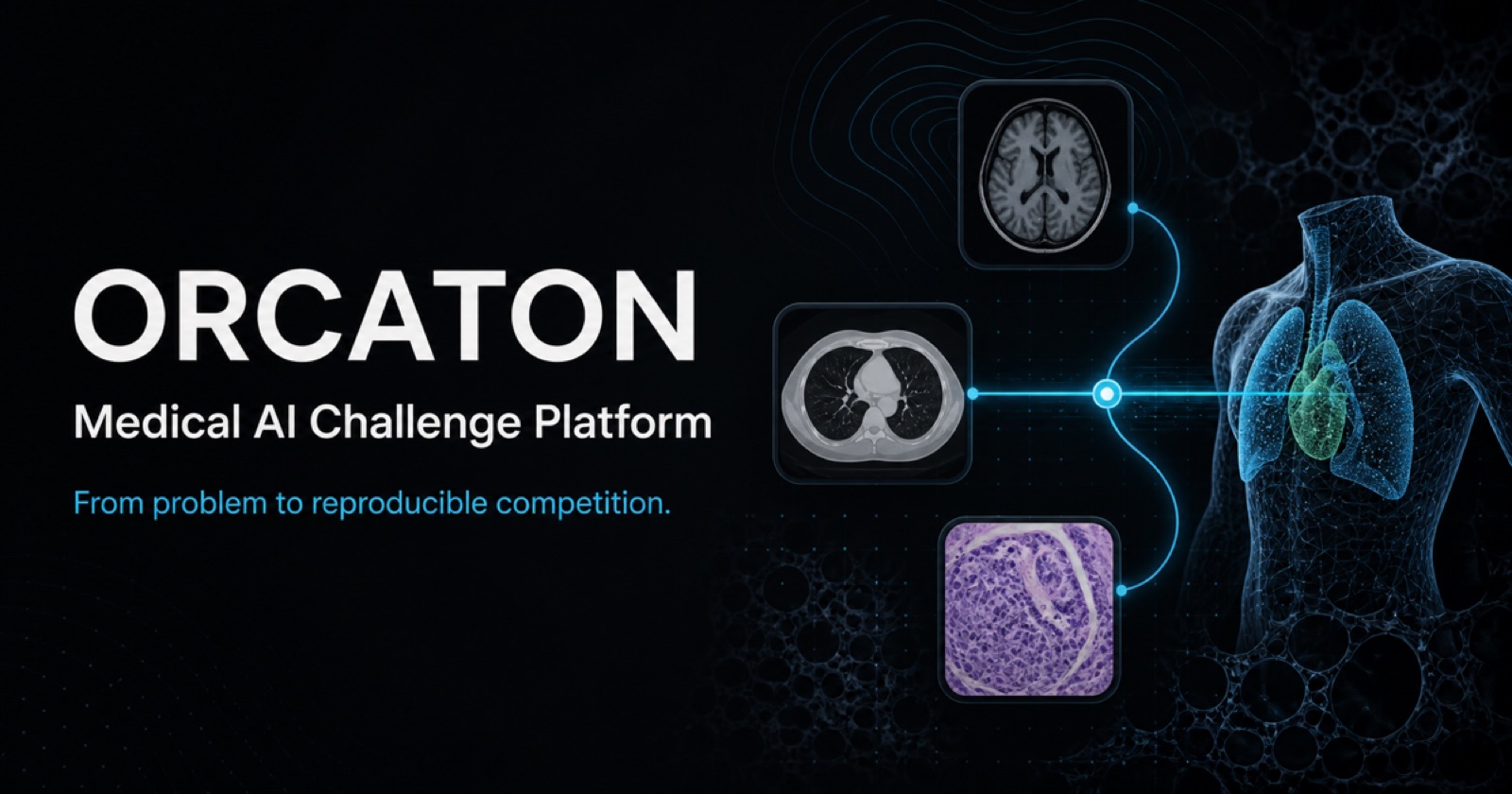
Orcaton shares identity, competition rules, submissions, evaluation versions, leaderboards, cost records, and incident logs. Domain-specific formats and evaluators stay separated inside OrcaImage, OrcaPath, and OrcaDose.
What is working now
- Publish a synthetic challenge.Organizers define the task, tracks, dates, submission rules, and evaluation version.
- Register and submit.Participants join a competition and upload through expiring object-storage URLs rather than routing large files through the web server.
- Score out of band.A worker claims a database-backed job, runs the domain evaluator, and writes a versioned scorecard.
- Compare results.The platform publishes a leaderboard while preserving submissions, scorer versions, and run status.
- Operate the event.Organizer views cover approvals, costs, incidents, and the evidence needed for a closeout report.
Operational architecture
The live deployment uses Caddy for TLS, a Next.js application, PostgreSQL, MinIO object storage, and polling Python workers. Large uploads go directly from the browser to object storage with presigned URLs. The viewer remains loopback-only, and workers listen on no public port.
What still requires a real partner
The current public competitions use synthetic data. A real challenge still needs an institution with lawful, de-identified data; a society or clinical principal investigator to own the evaluation criteria; an approved compute environment; and human review of consent, DUA, privacy, and governance language. The platform does not manufacture those authorities.
The product hypothesis
The claim is not that vendors should disappear, or that software can replace governance. The hypothesis is narrower: challenge infrastructure can become reusable enough that a society or research group controls the scientific question, while the platform handles repeatable operations. Whether that becomes a sustainable service depends on finding partners who value independence, auditability, and continuity more than another custom event website.
← All projects