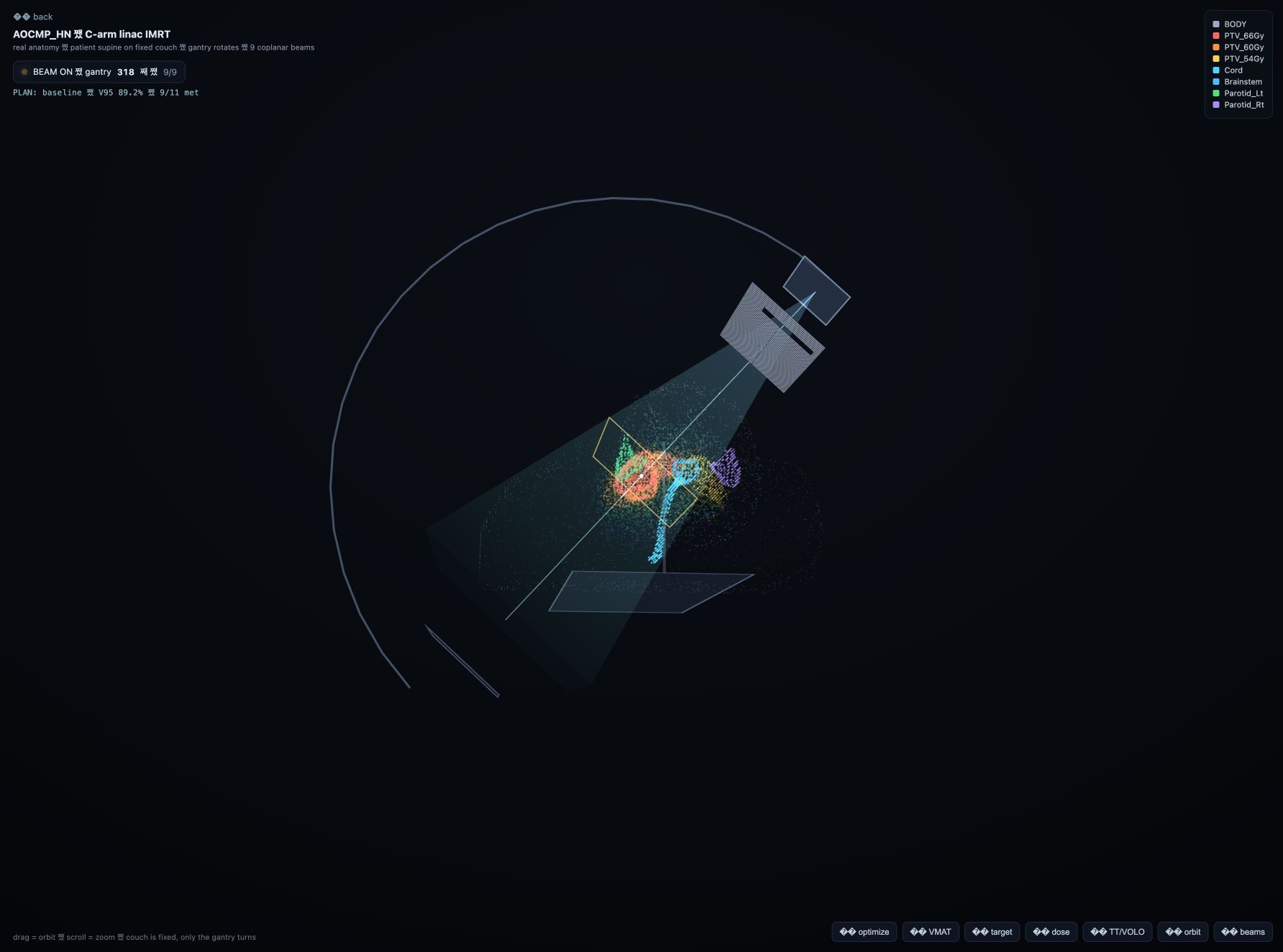
How a researcher uses it
- Load a case.Import CT and RTSTRUCT data, or start with a committed open phantom such as TG-119.
- Define the planning problem.Select targets, organs, prescription, beam geometry, and measurable dose objectives.
- Optimize and inspect.Run fluence optimization, compare DVHs, and navigate trade-offs rather than accepting a single opaque answer.
- Make it deliverable.Sequence fluence into MLC apertures and check leaf, gantry, MU, and timing rules on the virtual machine.
- Challenge the result.Recalculate with an independent Monte Carlo experiment and export research DICOM objects for inspection.
The question
Can the important pieces of a radiotherapy treatment-planning system be reproduced in a form that a researcher can read, rerun, challenge, and extend—not merely view through a vendor interface?
What I built
The stack imports CT and RTSTRUCT data, optimizes fluence with pyRadPlan, explores multi-criteria trade-offs, converts fluence into MLC apertures, checks machine rules on a virtual linac, and exports research RTPLAN and RTDOSE objects. Separate CPU and CUDA experiments model photon/electron transport and proton and carbon Bragg peaks.
Reproducible evidence
Committed scripts cover water-phantom buildup and PDD, proton and carbon range, HU-to-stopping-power calibration, TG-119 optimization, VMAT aperture experiments, breast-cohort comparisons, and a TOPAS cross-check. The purpose is not to claim clinical equivalence; it is to expose exactly which result came from which model and script.
The boundary matters
This is research software, not a medical device or a clinical TPS. The dose grid and several physics models remain simplified; the virtual machines have not been commissioned against a physical linac; measured profiles, end-to-end patient QA, carbon fragmentation, and biological weighting remain outside the validated scope.
← All projects